# Inventory a site in report-only mode (/docs/consent-management/security-controls/inventory-a-site-in-report-only-mode)
Admin Dashboard pages: /consent-manager/data-flows/*, /consent-manager/cookies/*, /consent-manager/developer-settings/*, /consent-manager/developer-settings, /consent-manager/developer-settings/installation, /consent-manager/data-flows, /consent-manager/cookies
After this guide, you can list every host and cookie that a site uses. airgap.js blocks nothing while you do this. Use the list to decide what to approve before you [block unknown requests](./block-unknown-requests.mdx).
For how report-only mode fits next to a Content Security Policy (CSP), see the [overview](./overview.mdx).
**Diagram: Rolling out airgap.js in five steps.** Observe first: run airgap.js in report-only mode, which logs every host in telemetry and blocks nothing, then approve the hosts you trust in Triage. Then enforce: set the Unknown Request Policy to Block, which stops hosts outside your data flows and adds a generated Content Security Policy (CSP). Turn on navigation control, then set a strict CSP on high-risk pages such as checkout.
## Before you start [#before-you-start]
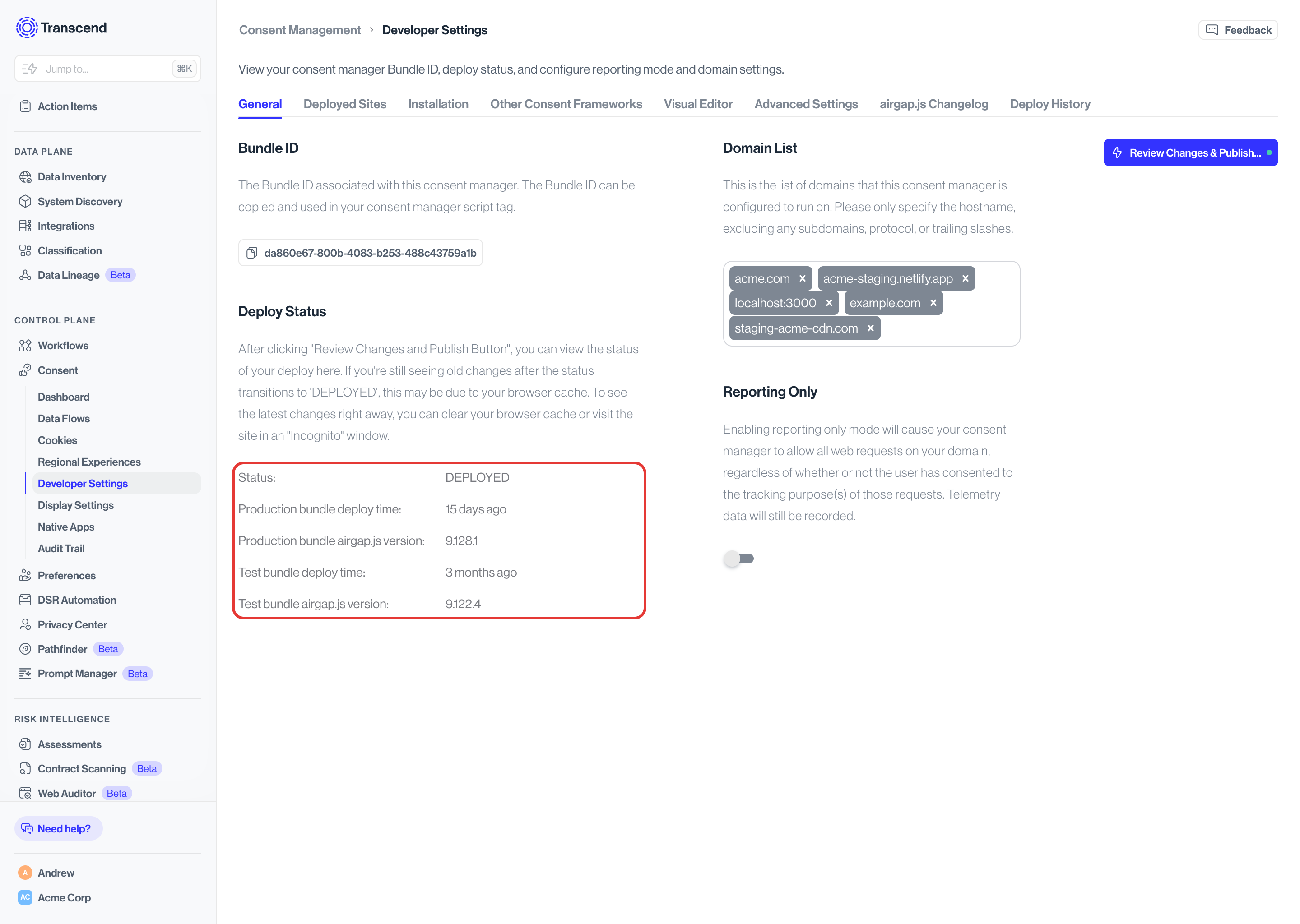
- Your site host is in your domain list. airgap.js throws an error on a host that is not on the list. You manage the list in [**Consent Management → Developer Settings**](https://app.transcend.io/consent-manager/developer-settings), in the **Domain List** field of the **General** tab.
- You have your bundle ID. Copy it from the **Bundle ID** field of the same tab. The HTML snippet on the **Installation** tab already contains it.
## Add the report-only tag [#add-the-report-only-tag]
1. Add the tag as the first script in the `` of the site. It must load before every other script. The [**Installation** tab](https://app.transcend.io/consent-manager/developer-settings/installation) shows the base snippet.
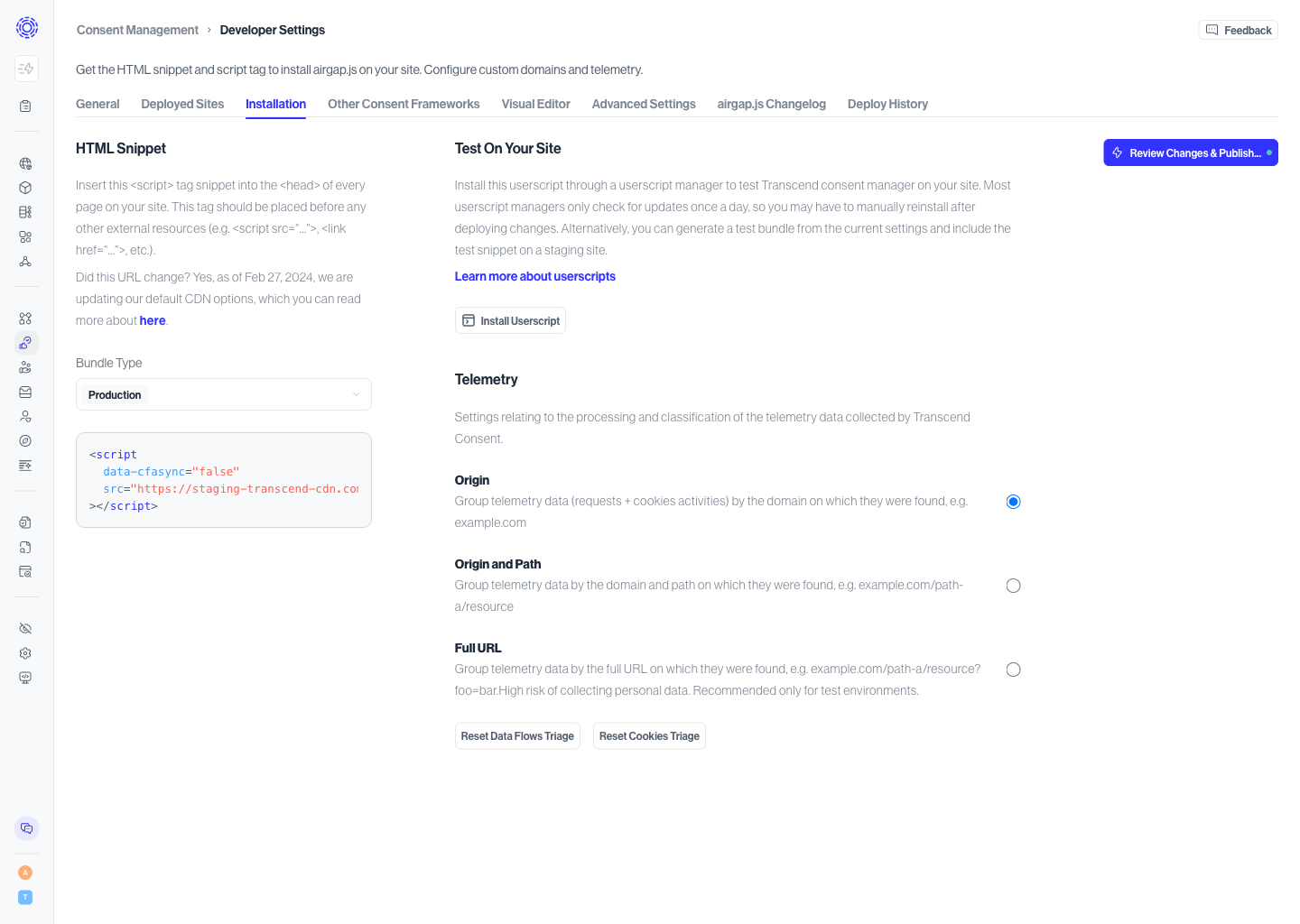
Add the three extra attributes below to that snippet.
```html
```
2. Deploy the page.
Each attribute does one job:
| Attribute | What it does |
| -------------------------- | ----------------------------------------------------------------------------------------------------------------------------------------------------------------------------------------------------------------------------------------------------------------- |
| `data-report-only="on"` | Turns off request and cookie regulation and the generated CSP. airgap.js records what it sees and blocks nothing. |
| `data-monitoring="export"` | Keeps a list of sent requests and set cookies that you can read with `airgap.export()`. |
| `data-tfpf="off"` | Turns off telemetry false positive filtering. That filter hides requests that look like they come from browser extensions. See [Telemetry configuration](../configuration/triaging-and-telemetry/telemetry-configuration.mdx#telemetry-false-positive-filtering). |
Turn `data-tfpf="off"` on for internal tools that you test yourself. On public sites, leave the filter on so visitor extensions do not add noise.
In report-only mode, airgap.js does not block requests, cookies, or navigations, and it does not generate a CSP. To also list navigations in telemetry, add `data-regulate-navigation="report-only"` to the tag. See [Navigation control](../reference/navigation-control.mdx#report-only-mode).
## Confirm airgap.js is running [#confirm-airgapjs-is-running]
1. Load the site and open the browser console.
2. Run these commands:
```js
airgap.version;
airgap.loadOptions.reportOnly;
```
`airgap.version` returns the airgap.js version. `airgap.loadOptions.reportOnly` returns `"on"`.
airgap.js defines `airgap` in the frame where its script tag runs. If the site loads the tag inside an iframe, a console that points at the top frame shows `airgap is not defined`. Use the JavaScript context selector at the top of the console to pick the iframe.
Cookie regulation and cookie-based sync need both `allow-scripts` and `allow-same-origin` in the iframe `sandbox` attribute. In airgap.js 9.183.1 and later, a frame with only `allow-scripts` still starts, but consent does not persist there. See the [FAQ](../testing-and-troubleshooting/faq.mdx#can-transcend-consent-management-be-used-inside-sandboxed-iframes).
## Browse the site [#browse-the-site]
1. Open the pages that matter, including pages behind a login. airgap.js runs in each visitor's browser, so it sees pages that an external scanner cannot reach.
2. Walk through the main flows, such as sign in, checkout, and settings.
airgap.js sends the hosts it sees to Transcend telemetry. If your site sends its own CSP header, allow the telemetry host first. See [Integrating with an existing CSP](../concepts/content-security-policies.mdx#integrating-with-an-existing-csp).
## Read the list in your browser [#read-the-list-in-your-browser]
Run this in the console of the frame that loaded the tag:
```js
const { version, sentRequests, setCookies } = airgap.export();
console.table(sentRequests.map(({ type, url }) => ({ type, url })));
console.log([...new Set(sentRequests.map(({ url }) => new URL(url).host))]);
console.log(setCookies);
```
- `sentRequests` lists requests that the browser sent. Each entry has a `type` and a `url`.
- The first `console.log` prints each unique host once.
- `setCookies` lists cookies that scripts set.
To save the list as a JSON file, run `airgap.export({ save: true })`. See [Useful commands](../testing-and-troubleshooting/debugging-and-testing.mdx#useful-commands) for more console commands.
## Find the hosts in Triage [#find-the-hosts-in-triage]
1. In the Admin Dashboard, go to [**Consent Management → Data Flows → Triage**](https://app.transcend.io/consent-manager/data-flows).
2. Find each host that you saw in the console.
3. For cookies, go to [**Consent Management → Cookies → Triage**](https://app.transcend.io/consent-manager/cookies).
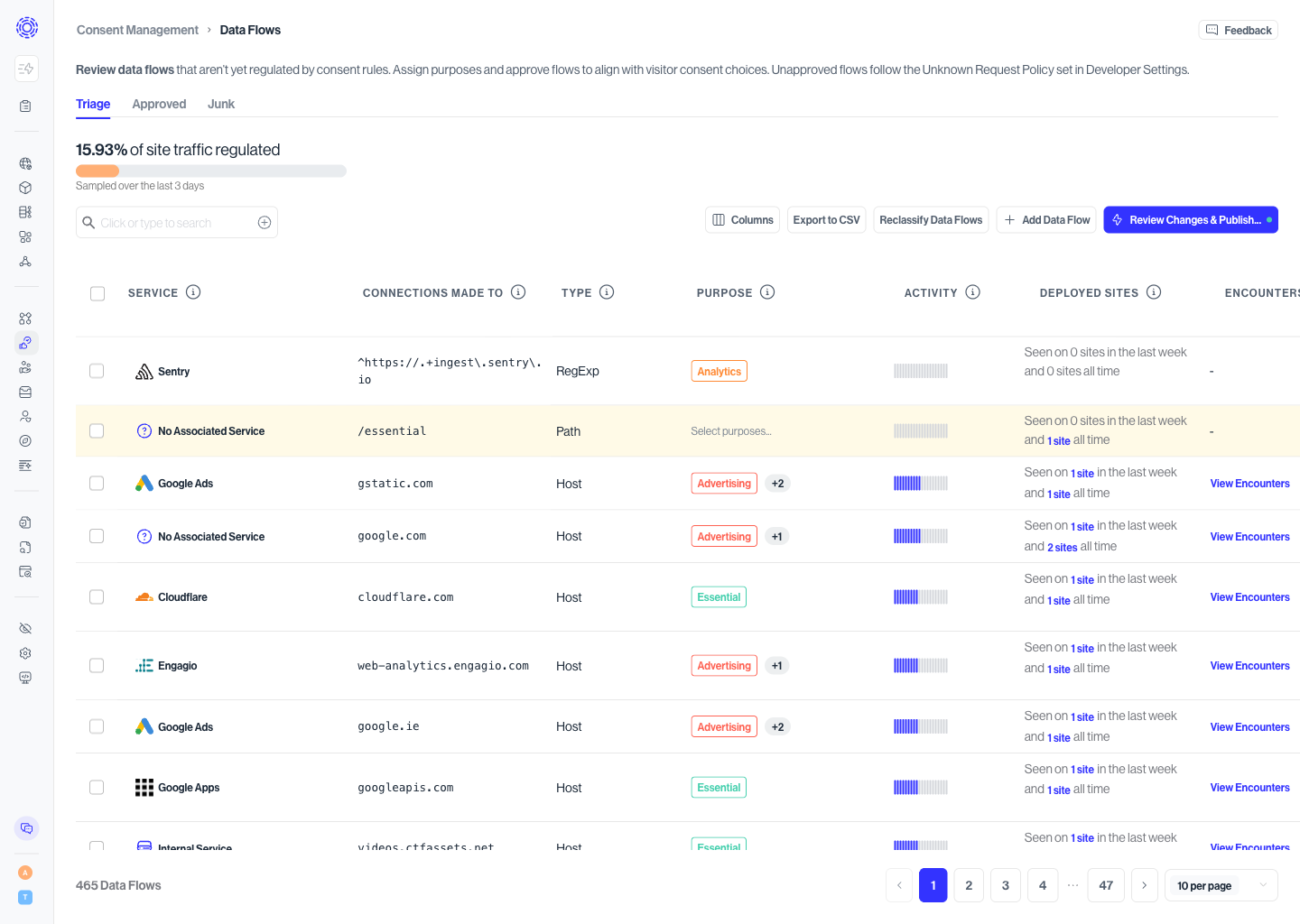
If a host is missing from Triage, check two things:
- The tag does not set `data-telemetry="off"`.
- Your CSP header allows the telemetry host.
To learn more about what telemetry reports, see [Telemetry configuration](../configuration/triaging-and-telemetry/telemetry-configuration.mdx).
## Next steps [#next-steps]
1. Classify each host. See [Guide to triaging data flows and cookies](../configuration/triaging-and-telemetry/triage-cookies-and-dataflows-guide.mdx).
2. Keep your settings in a file that your team reviews. See [Manage consent config as code](./manage-consent-config-as-code.mdx).
3. Move the site to Block. See [Block unknown requests](./block-unknown-requests.mdx).